The sentence that matters is not “psilocybin fixes the gut.” It is this: when fecal microbiota from people with severe anxiety were exposed to a psilocybin-containing Psilocybe cubensis extract in an in vitro colon model, the microbial system changed its chemistry.
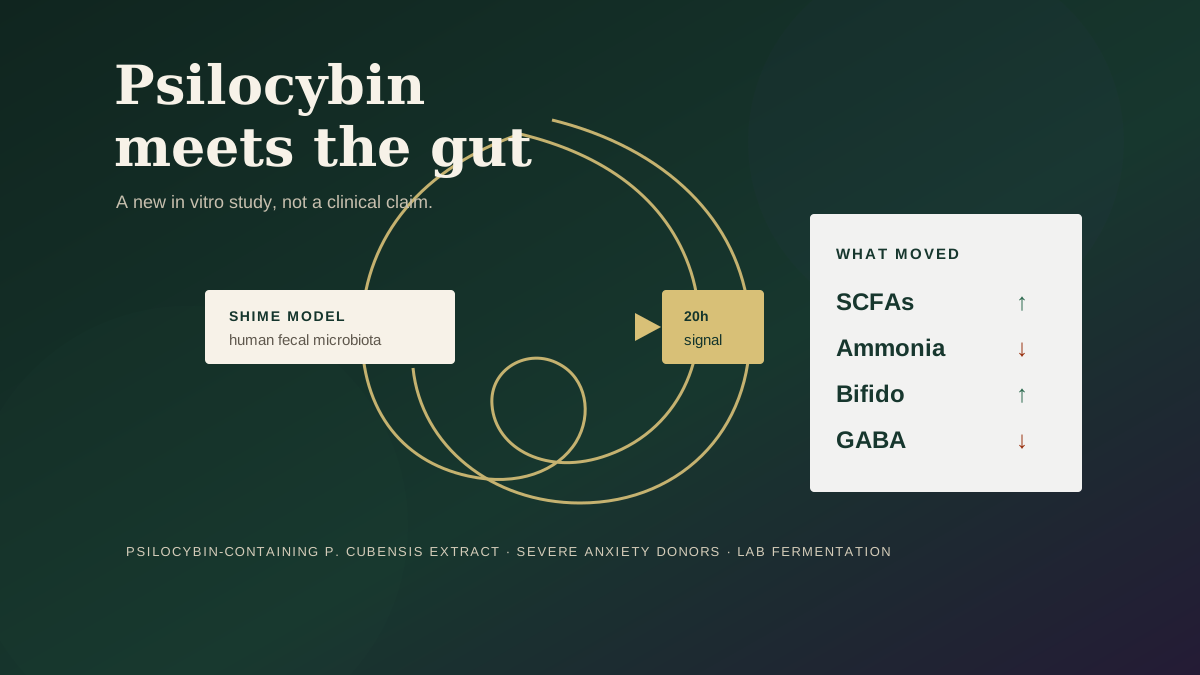
The paper is by Salgaço and colleagues, published on 12 August 2026 in Drugs and Drug Candidates. It is open access, small, technical, and easy to overread. It also lands in a space that has been mostly theory, review articles and animal work: the possibility that psychedelics interact with the microbiota-gut-brain axis rather than acting only through receptors in the brain.
That is why it is worth taking seriously. Not as proof. As a useful new piece of the map.
What they actually did
The researchers recruited three fecal donors with severe anxiety, pooled that microbiota, and used a SHIME system: a dynamic in vitro model designed to simulate parts of the human gastrointestinal tract. After a stabilization and control period, they added a single dose of P. cubensis mushroom extract directly to the colonic vessels, providing a psilocybin concentration of 35 mg/L.
That is not the same as giving a person mushrooms. There is no absorption into blood, no liver metabolism, no nervous system, no subjective experience, no therapy room, no clinical outcome and no headache outcome. The study asks a narrower question: if this extract meets a human-derived gut microbial community under controlled lab conditions, does the microbial community respond?
The answer was yes.
Boundary
This was mushroom extract, not pure psilocybin; a lab colon model, not a person; and severe-anxiety donor microbiota, not cluster headache microbiota. It does not show that psilocybin treats anxiety through the gut, and it says nothing directly about cluster headache treatment.
The headline result: microbial metabolism shifted
The cleanest result is the short-chain fatty acid signal. After 20 hours, acetic acid, propionic acid and butyric acid were all markedly higher, and that elevation persisted through the 15-day fermentation period.
SCFAs matter because they are not just gut exhaust. They are microbial metabolites that can affect epithelial barrier function, immune signalling, energy metabolism, enteroendocrine signalling and, indirectly, brain-relevant pathways. Butyrate in particular is often discussed because of its role in colonocyte energy metabolism, barrier integrity and histone deacetylase inhibition.
That does not mean “more SCFAs equals cured anxiety.” Biology is not that tidy. But if the question is whether psilocybin-containing material can push a gut microbial ecosystem toward a different metabolic state, the SCFA result is the strongest part of the paper.
Ammonia went down
Ammonia also moved in the useful direction. The study reported a 19% reduction after 20 hours and a 25% reduction after three days, then roughly stable levels through the rest of the run. The authors interpret this as a possible reduction in proteolytic activity within the fermentation system.
This is interesting because ammonia is a microbial waste product with well-known toxicity at high levels. But again, context matters. The paper does not show a clinical ammonia problem being corrected in people. It shows that, in this controlled microbial model, the extract changed the balance of microbial metabolic output.
Bifidobacterium and Lactobacillus rose, but diversity did not
On the bacterial composition side, the main taxa that moved were familiar names: Bifidobacteriaceae increased early and through days 3 to 12, while Lactobacillaceae showed a stronger increase by day 15. At genus level, Bifidobacterium increased after 20 hours and through the middle of the run, while Lactobacillus rose later.
That is the part that will make the internet want to say “psilocybin is a probiotic.” It is not. The study did not show a broad improvement in alpha diversity, and the Shannon diversity index tended downward without a significant difference. A more honest read is that the extract changed the community structure and metabolic activity in specific ways.
| Signal | What happened | How to read it |
|---|---|---|
| SCFAs | Acetate, propionate and butyrate rose after 20 hours. | The strongest functional result. Suggests a shift toward carbohydrate fermentation. |
| Ammonia | Reduced 19-25%. | Potentially favourable, but still an in vitro metabolic marker. |
| Bacteria | Bifidobacterium and Lactobacillus increased. | Interesting taxa shift, not a probiotic claim. |
| GABA | Reduced by days 9 and 15. | Not obviously good or bad. It may reflect microbial use and turnover. |
| Barrier/immune | TEER trended up; IL-6 fell; TNF-alpha rose. | Mixed immunomodulation, not clean anti-inflammatory suppression. |
The weird result: GABA went down
GABA fell from 285.30 µmol/L in the control condition to 179.60 µmol/L after nine days and 151.32 µmol/L after 15 days. That is not the result a simple gut-brain influencer would want. Many people hear GABA and think “calming neurotransmitter,” therefore more must be better. But microbial GABA metabolism is not a wellness slogan.
Some bacteria produce GABA. Others consume it. GABA can be converted into succinic semialdehyde and then succinate, feeding into other metabolic pathways. The authors frame the result as possible microbial degradation and utilization of GABA in the presence of the mushroom extract. That is plausible, but it remains an open mechanistic question.
For a podcast breakdown, this is the teaching moment: the gut-brain axis is not a row of green ticks. A real signal can be mixed, awkward and still worth following.
Where this fits with the last year of psychedelic microbiome work
The paper did not land in a vacuum. The last year has seen a small cluster of psychedelic-gut-brain writing: the ACS Chemical Neuroscience viewpoint on psychedelics and the gut microbiome, the Neurobiology of Stress review asking whether the gut-brain axis can help explain psilocybin's therapeutic value in stress, and preclinical work suggesting psilocybin can alter both behaviour and microbiome composition in rodents.
Most of that literature is still conceptual or animal-based. This new paper is useful because it adds a different kind of evidence: a controlled human-derived microbial fermentation model. It does not answer the clinical question, but it narrows the mechanism question. It says the gut microbial environment is not inert in the presence of psilocybin-containing mushroom extract.
Why I care, as a cluster headache patient
This is not a cluster headache paper. It should not be presented as one. But it intersects with several things the cluster headache community already cares about: psilocybin, inflammation, sleep, serotonin, tryptamine chemistry, vitamin D, the microbiome and the huge variability in patient response.
The community has long treated psilocybin mostly as a central nervous system story: receptors, hypothalamus, serotonin, attack cycles. That story is still central. But oral psilocybin does not teleport into the cortex. It enters through the gut, moves through digestion, is metabolised, and meets a microbial ecosystem whose state varies wildly between people.
That gives us a better question than “does the gut cause the effect?” The better question is: could gut microbial state shape the response, the tolerability, the inflammatory background or the durability of response for some people?
No one has answered that in cluster headache. But after this paper, it is harder to dismiss the question as fringe.
The honest conclusion
This study is not proof that psilocybin treats anxiety through the microbiome. It is not evidence to change treatment. It is not a reason to self-experiment. It is not a cluster headache result.
It is a mechanistic signal. In a human-derived gut fermentation model, a psilocybin-containing mushroom extract shifted microbial metabolism: SCFAs up, ammonia down, Bifidobacterium and Lactobacillus up, GABA down, immune and barrier signals mixed. That is enough to justify a careful explainer, and enough to put the microbiome on the list of things psychedelic research should measure rather than assume away.
Podcast version
The best spoken version is simple: “A new psilocybin study did not look at mystical experience. It looked at gut fermentation. And the gut moved.” From there, the job is to keep the excitement and the boundary in the same sentence.
References
- Salgaço MK, Farias DP, de Souza MZ, et al. Exploring the In Vitro Effect of Psilocybin on the Composition and Metabolic Activity of Gut Microbiota in Individuals with Severe Anxiety. Drugs Drug Candidates. 2026;5:46. doi:10.3390/ddc5030046.
- Wang X, Jun F, Lin C, Wang X. Psychedelics and the Gut Microbiome: Unraveling the Interplay and Therapeutic Implications. ACS Chemical Neuroscience. 2025;16(15):2753-2755. doi:10.1021/acschemneuro.5c00418.
- Kit A, et al. Can the gut-brain axis provide insight into psilocybin's therapeutic value in reducing stress? Neurobiology of Stress. 2025;36:100732. Available from PubMed Central.
- Gattuso JJ, Kong G, Bezcioglu B, et al. Chronic psilocybin administration increases sociability and alters the gut microbiome in male wild-type mice but not in a preclinical model of obsessive-compulsive disorder. Neuropharmacology. 2025;279:110648.
- Reed F, et al. Do the therapeutic effects of psilocybin involve actions in the gut? Trends in Pharmacological Sciences. 2024.