This is a patient hypothesis, not a treatment claim. It picks up exactly where The Vitamin D3 Seesaw stopped. That piece argued D3 is a counterweight: it presses down on the inflammatory side of the balance without removing whatever loads it. It left one question open and unanswered - what is on the other side? This is my attempt at a candidate answer. I cannot prove it. But I think I can show why the gut belongs in the question.
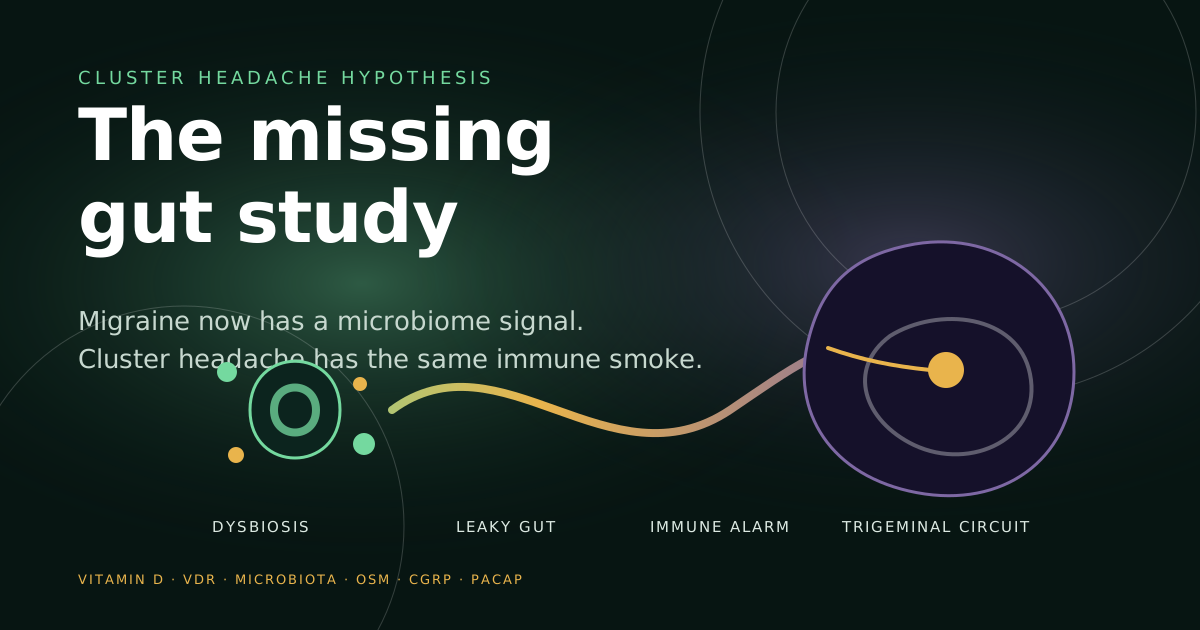
Where the seesaw left off
If this idea is wrong, it should be easy to test. That is exactly why it is worth writing down.
Vitamin D can turn down the expression of inflammatory signals. It does not explain what keeps producing them. That gap is the whole reason the seesaw is only a counterweight and never a cure - press down on one side all you like, something on the other side is still pushing up. So the next move is not to admire the counterweight. It is to go looking for the load.
Cluster headache behaves like a whole-system disorder, not a local pain. One-sided orbital fire, tearing, nasal congestion, agitation, broken sleep, circadian precision, seasonal recurrence. The modern model centres the hypothalamus, the trigeminal-autonomic reflex, CGRP and PACAP,9 and it is right to. But a system with that many moving parts rarely runs on a single input.
That is the argument I made in Beyond the Silos: hypothalamus, inflammation, bioenergetics, vitamin D and the microbiome are not five separate conversations. They may be five windows onto one unstable system. And lately the field has started taking the immune part seriously. Nunu Lund and colleagues found distinct inflammatory biomarker patterns across chronic cluster, episodic cluster in bout, episodic cluster in remission and matched controls - and Oncostatin M was elevated in all three cluster states.3 PACAP-38 looks elevated across states too.4 The signal does not switch cleanly off between attacks.
None of that proves the gut is involved. It does something narrower and more useful: it puts the immune system on the map. And once the immune system is on the map, the gut is hard to leave off it - because the gut is one of the largest immune training grounds the body has.
The clue hiding in the vitamin D data
Here is the paper that reorganised how I think about all of this. Zeb and colleagues published a systematic review in Nutrition Reviews asking a plain question: does vitamin D supplementation change the human gut microbiota? Fourteen randomized controlled trials, 1,458 participants - healthy adults and patients with cancer, cystic fibrosis, HIV and obesity.2 It studied neither migraine nor cluster headache, so nothing in it carries over to cluster headache on its own. What it changes is what we know vitamin D is capable of.
But look at what it found. Vitamin D supplementation repeatedly shifted microbiota composition - reported increases in Bifidobacterium, Lactobacillus, Akkermansia, Bacteroides / Parabacteroides, movement in the Bacteroidetes-to-Firmicutes ratio, and changes in gut biomarkers such as calprotectin and TMAO. Some trials improved diversity, some did not. The authors are careful - heterogeneous, not yet standardised. But the direction is consistent: vitamin D changes the ecology of the gut.
Now hold that against the seesaw. When I drew D3 as a counterweight, I quietly assumed the counterweight and the load were separate things - D3 over here, leaning on inflammation that is produced somewhere else over there. This review breaks that assumption. If part of the inflammatory load is generated in the gut, and vitamin D remodels the gut, then the counterweight may be acting on the load itself - less like two systems balanced against each other, and more like one system quietly grooming the other.
And the review does not leave that as my inference. Its own discussion spells out the bridge: vitamin D works through the VDR, and in the gut that same receptor improves intestinal barrier function, increases short-chain fatty acid synthesis, restrains dysbiosis - and lowers inflammation by blocking NF-κB signalling.2 That last detail is the one that matters here. NF-κB is the exact pathway I described in the Seesaw piece - the master inflammatory switch D3 leans on to hold its side of the balance down. The review puts that same switch in the gut wall. One receptor, one pathway, doing the anti-inflammatory work and the gut-remodelling work at once. So the counterweight and the load may not only overlap; they may share a mechanism.
That reframes the question the cluster community usually asks about vitamin D. The usual question is "does D3 suppress inflammation?" The sharper one is: does D3 help remodel the gut environment that keeps feeding the inflammation? If the answer is yes, it would explain things the simple anti-inflammatory story struggles with - why D3 has to be sustained, why doses creep upward, why it behaves like ongoing management rather than a fix. You do not flip an ecology like a switch. You garden it, and you keep gardening it.
The seesaw said the counterweight never removes the load. This says the counterweight might, slowly, be reaching for it.
What migraine already shows
The reason this is not pure speculation is that the neighbouring disease has already walked the path. Migraine is not cluster headache; they are different disorders. But it is the closest headache cousin we have, and its microbiome literature is years ahead of ours.
A 2025 systematic review in The Journal of Headache and Pain found migraine patients show altered gut microbiome composition compared with controls - reduced species number in several studies, shifted alpha and beta diversity, and differences in taxa such as Faecalibacterium, Bifidobacterium, Lactobacillus and Veillonella.1 The same review reported that synbiotic and probiotic combinations reduced migraine frequency, severity, duration and painkiller use across several randomized trials. Not a finished therapeutic blueprint - the authors are blunt about heterogeneity and weak methods - but no longer fringe.
This builds on The Migraine-Gut Connection, and it hands cluster headache a ready-made mechanism to borrow and test: dysbiosis can cut microbial diversity, lower short-chain fatty acid production, weaken the gut barrier, let lipopolysaccharide signals press on the immune system, shift cytokine tone, move serotonin and tryptophan metabolism, and interact with CGRP-bearing trigeminal pathways.1810 Every one of those words already lives somewhere in the cluster conversation - inflammation, serotonin, CGRP, PACAP, sleep, energy, immune state. Migraine has simply joined them up first.
The vitamin D microbiome review did not study cluster headache. The migraine microbiome studies are migraine, not cluster. None of it transfers automatically. The point is not proof - it is that the seesaw, the immune signal and the gut now overlap enough to justify a direct cluster headache study instead of a guess.
Where Oncostatin M fits
Oncostatin M is not a microbiome biomarker in cluster headache. It is a cytokine, part of the interleukin-6 family, and Lund's study makes it interesting because it was elevated across chronic cluster headache, episodic cluster in bout and episodic cluster in remission.3 That persistence is what catches my attention. It suggests the immune signal is not merely a byproduct of the attack.
The wider literature gives OSM two reasons to be taken seriously. First, OSM has been implicated in intestinal inflammation. West and colleagues reported that OSM drives intestinal inflammation and predicts response to anti-TNF therapy in inflammatory bowel disease.5 Second, OSM has a pain-neuron story. Earlier work found an essential role for OSM in nociceptive neurons of dorsal root ganglia, and reported OSM receptor expression in adult trigeminal and dorsal root ganglia.6 More recent work showed OSM can sensitize sensory neurons in inflammatory itch rather than simply activating them outright.7
That gives us a possible bridge, not a verdict: a cytokine elevated in cluster headache, known in other contexts to sit at the intersection of mucosal inflammation and sensory-neuron sensitisation. If the gut barrier is disturbed in a subset of cluster patients, OSM is one of the immune signals I would want measured alongside microbiome composition, calprotectin, LPS-binding protein, CRP, IL-1β, PACAP-38 and CGRP.
If that link fails, leave OSM out. But right now, it is too biologically well-positioned to ignore.
The evidence ledger
This is the discipline the cluster headache field needs more of: separate what is known, what is plausible, and what is still only a research question.
The study I want run
The first study does not need to be exotic. It needs to be clean.
- Groups: chronic cluster headache, episodic cluster in bout, episodic cluster in remission, matched controls.
- Samples: stool microbiome, blood inflammatory markers, vitamin D metabolites, calcium, PTH, magnesium, CRP, LPS-binding protein, calprotectin and metabolomics.
- Cluster markers: PACAP-38, CGRP where feasible, OSM, IL-1β and the other cytokines from Lund's biomarker panel.
- Controls: diet, smoking, alcohol, antibiotics, PPIs, NSAIDs, triptans, verapamil, steroids, sleep timing and bowel disease history.
- Timing: sample in bout, remission, before and after preventive changes, and ideally around a ketogenic or vitamin D intervention arm.
The key question is not "does every cluster patient have dysbiosis?" That is too crude. The better question is whether a measurable gut-immune phenotype marks a subgroup, predicts bout state, explains treatment response, or helps distinguish chronic from episodic biology. And the vitamin D arm is where the centerpiece claim lives or dies: if D3 changes the cluster gut in the same direction it changes everyone else's, the counterweight is touching the load, and we will finally have caught it doing so.
If the answer is no, we learn something. If the answer is yes, we finally have an upstream system that connects diet, vitamin D, inflammation, serotonin, mitochondrial metabolism and the trigeminal-autonomic circuit in one testable frame.
The claim is not that the gut causes cluster headache. It is smaller and stranger: the counterweight I already rely on may be quietly working on the very load it was only supposed to balance.
Where this leaves us
If D3 reaches the gut, the gut stops being a side topic in the vitamin D conversation. It may be part of the mechanism itself - the part people have spent years crediting to something else. That is the practical reason this is worth getting right, and it is a narrower claim than it sounds: not a new thing to take, but a better account of why a thing some people already take seems to work.
And the gut does not sit alone. Oxygen works too fast to be a vague wellness effect. DMT reports, whatever one makes of them, are interesting because patients describe an attack changing within seconds, not hours - which is why I treated DMT separately in DMT and Cluster Headache: A 30-Second Smoking Gun?. The ketogenic diet produced a striking open-label result in drug-resistant chronic cluster headache, and a ketogenic diet is, among other things, a microbiome intervention. Migraine is already showing the gut-brain axis can move headache biology. The threads keep meeting in the same place.
None of this abandons the seesaw. It follows it down to the floor. D3 holds one side; the gut may be helping set the weight on the other. The gut may not turn out to be the answer. But a disease with this much immune signal, this exact a clock, and a vitamin D clue that now points straight at the microbiome is worth looking into properly - and so far, almost no one has.