I built OpenAir VCD because breathing disorders that involve the larynx can be frightening, poorly understood and surprisingly hard to explain to other people. The app is not a treatment or a diagnosis. It is a calm place to practise the breathing techniques people are often taught by clinicians, and to understand the condition in plain language.
What are VCD, PVFM and ILO?
The naming can be confusing. Vocal Cord Dysfunction (VCD), Paradoxical Vocal Fold Motion (PVFM) and Inducible Laryngeal Obstruction (ILO) are overlapping terms often used to describe episodes where the vocal folds or nearby laryngeal structures narrow when they should be open for breathing.
ASHA describes ILO as intermittent, episodic adduction of the larynx during inspiration, induced by triggers such as irritants, activities or exposures. Cleveland Clinic explains it in patient language: the voice box tends to close when breathing in instead of staying open, which can make it difficult to move air into the lungs.
People may experience throat tightness, difficulty getting air in, noisy breathing on inhalation, sudden shortness of breath, coughing or a sense that the throat is closing. It can be mistaken for asthma, and sometimes both conditions can coexist.
Why breathing practice matters
The most useful part of the clinical story, at least for a patient, is that VCD/ILO is often managed with education, trigger awareness and respiratory retraining. Johns Hopkins describes treatment as often nonmedicinal and involving respiratory retraining therapy with a qualified speech-language pathologist. The goal is to help people identify triggers, reduce throat irritation, relax the throat and improve control of breathing during episodes.
That practice component is where a digital tool can help. Not by replacing the clinician, but by making the between-appointment work easier to remember, easier to repeat and less intimidating.
What OpenAir VCD does
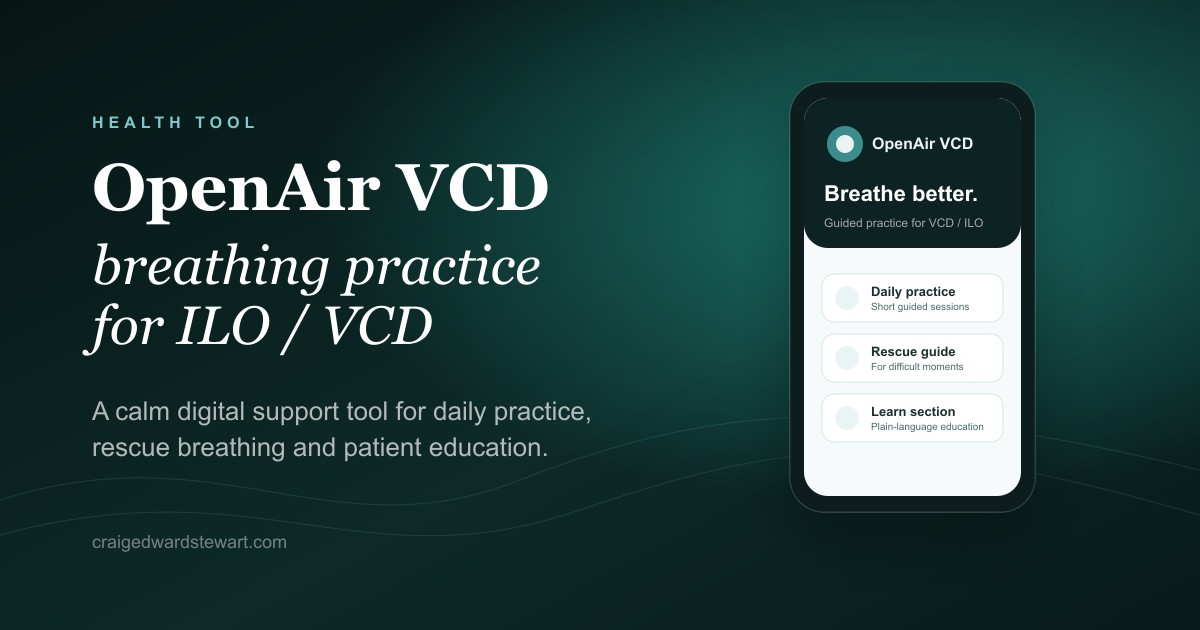
OpenAir VCD is designed around four simple jobs:
- Daily guided breathing practice with calm visual pacing.
- A rescue guide for moments when breathing feels difficult and the user needs a simple sequence to follow.
- A structured six-week pathway to support consistency over time.
- Plain-language education about ILO/VCD, symptoms, triggers, asthma overlap and what clinical treatment usually looks like.
It is deliberately quiet. No social features. No pressure. No complicated dashboard. The app is there to support practice and understanding.
Important health note
OpenAir VCD is not a medical device, diagnostic tool or substitute for professional care. If you are having severe or persistent shortness of breath, seek urgent medical help. If you suspect VCD, PVFM or ILO, work with an appropriately qualified clinician such as an ENT, respiratory specialist or speech-language pathologist.
Where it may be useful
A tool like this may be useful for someone who has already been assessed, has been taught breathing techniques, and wants a better way to practise consistently. It may also help people explain the condition to family, coaches, teachers or colleagues, because the Learn section gives a simple overview of what is happening in the larynx and why it can feel so alarming.
It may be especially helpful for the everyday gap that exists after an appointment: the clinician explains the concept, the patient understands it in the room, then real life happens and the practice disappears. OpenAir VCD is built for that gap.
Try OpenAir VCD
You can open the app here: openairvcd.craigedwardstewart.com.
If you use it, use it as support alongside proper clinical advice. The best version of this kind of tool is not the thing that replaces care. It is the thing that helps people practise what good care has already started.