


Introduction
While clinical research has historically prioritized migraine, non-migraine headaches—including tension-type and cluster headaches—account for a massive portion of global disability. Tension-type headaches, presenting as bilateral pressing pain, have a lifetime prevalence of up to 46 percent, while cluster headaches involve intense, localized ocular pain. By utilizing the 2019 UK Biobank pain questionnaire, this study aimed to define the underlying genetic pathways of non-migraine headache, addressing a significant knowledge gap regarding these prevalent but neglected conditions.
Infographic
Audio Summary
Key Findings
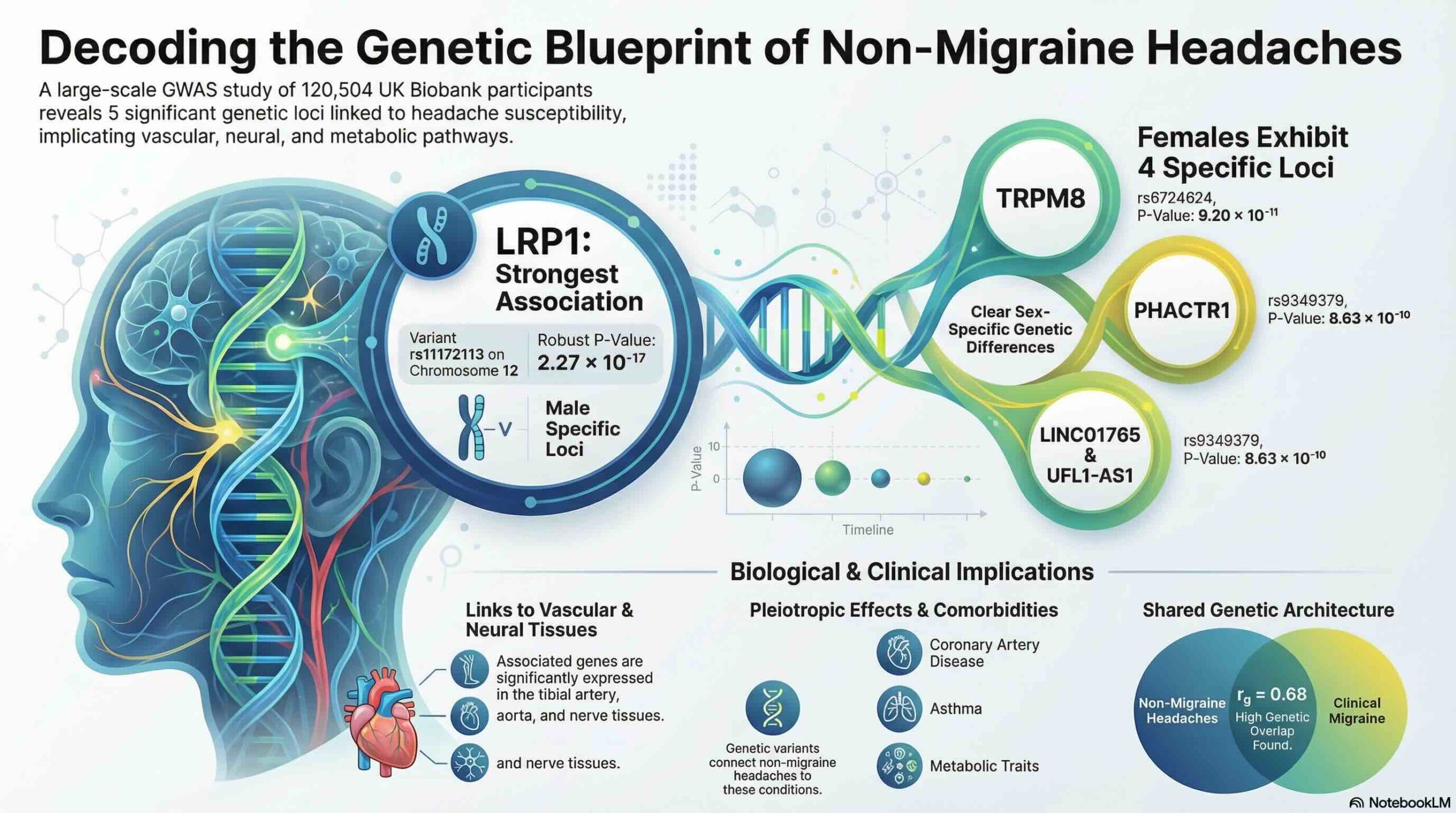
The genome-wide association study (GWAS) identified five genome-wide significant loci associated with non-migraine headache: LRP1, TRPM8, PHACTR1, LINC01765, and UFL1-AS1. The single nucleotide polymorphism (SNP) at LRP1 (rs11172113) demonstrated the strongest association (p = 2.27 × 10⁻¹⁷). Transcriptome-wide analysis showed these variants exhibit enriched expression in vascular, neural, and endocrine tissues. This suggests that the pathophysiology involves neurovascular coupling and vascular homeostasis, as these genes are active in circulatory and nervous system processes.
Sex-stratified analyses revealed a distinct genetic landscape between participants. The research identified four female-specific loci (TRPM8, STAT6/LRP1, SLITRK6, and PHACTR1), with STAT6 emerging as an additional relevant gene within the LRP1 region for females. In contrast, only the LRP1 locus achieved genome-wide significance in males. These results indicate that while the genetic architecture is largely shared between sexes, specific allelic variations may uniquely influence susceptibility in women.
Further investigation into comorbidities revealed a positive genetic correlation between non-migraine headache and traits such as stomach pain and depression, implicating shared biological pathways. However, the application of Mendelian randomization provided no evidence of a causal relationship between these conditions. These findings suggest that the observed epidemiological overlap is likely due to common genetic risk factors rather than one condition directly inducing another.
Conclusion
This study provides a comprehensive map of the genetic architecture underlying non-migraine headaches, distinguishing them from traditional migraine phenotypes. By identifying loci involved in vascular and neural functions, the research establishes a robust foundation for future investigations into the biological mechanisms of headache pain. While these findings advance the understanding of pathophysiology, they represent a step toward precision medicine within a research context rather than an immediate shift in clinical treatment.