Research Highlight: The Algorithmic Shift: Evaluating Machine Learning Capabilities in the Differential Diagnosis of Primary and Secondary Headaches

This systematic literature review (2020–2025) evaluates the emerging role of machine learning (ML) in the differential diagnosis and classification of primary and secondary headaches. The findings demonstrate that integrated ML models achieve up to 90% accuracy, effectively democratizing specialist-level diagnostic precision for non-specialist clinicians and enabling the transition from subjective symptom-reporting to objective, biomarker-driven diagnostics.
The Algorithmic Shift: Evaluating Machine Learning Capabilities in the Differential Diagnosis of Primary and Secondary Headaches

Background

In clinical neurology, the accurate classification of headaches is a high-stakes diagnostic imperative. Headaches are divided into primary types including migraine, tension-type, and trigeminal-autonomic cephalalgias (such as cluster headaches) – and secondary types, which are symptomatic of underlying, often life-threatening pathologies like cerebrovascular disease or intracranial hypertension.

The primary scientific problem is the inherent difficulty of rapid classification in acute settings. Because the clinical presentations of benign primary disorders and critical secondary conditions often overlap, there is a substantial risk of mortality associated with misdiagnosis. Current diagnostic paradigms rely heavily on subjective patient self-reporting, which is prone to recall bias. 

The integration of Artificial Intelligence (AI) and machine learning represents a timely shift toward objective “signature-based” diagnostics, providing the computational rigor necessary to detect subtle neurological biomarkers and improve patient safety.
 

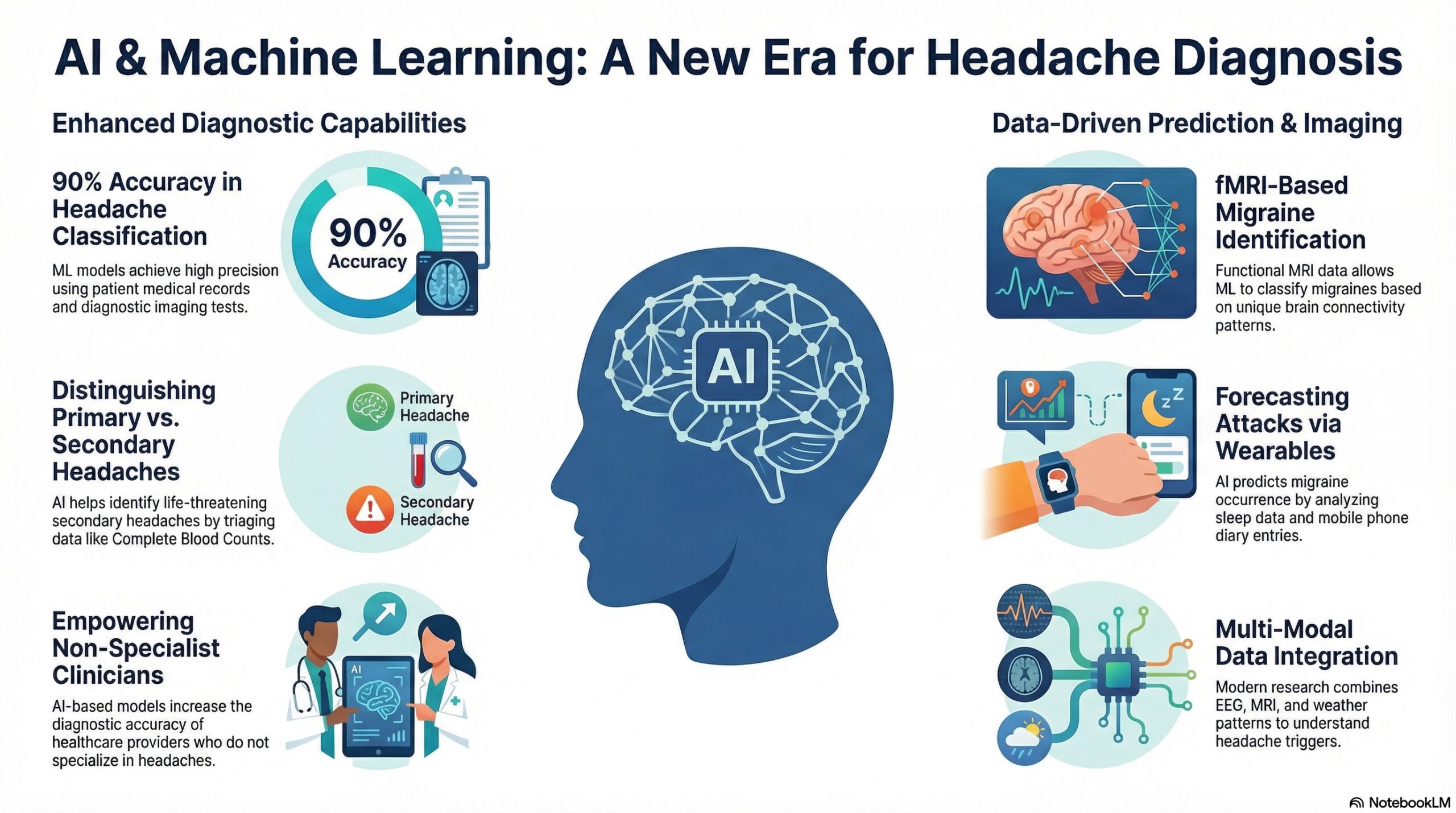
Infographic

Graphical Summary: Machine learning capabilities in headache diagnosis.

Research Question & Objectives

The primary objective of this study is to synthesize current machine learning capabilities in the diagnosis and classification of headaches by reviewing peer-reviewed literature from 2020–2025.
Secondary objectives include:
 
• Assessing the utility of AI-driven tools for non-specialist physicians in achieving specialist-level accuracy.
• Evaluating the predictive capacity of ML models in forecasting the onset of headache attacks.
 

Methodology

This study was conducted as a systematic literature review utilizing the PubMed and Google Scholar databases. The research focused on the five-year window of 2020–2025 to capture the most recent advancements in the field.

Search Parameters and Data Acquisition:
 
• Keywords: “Machine learning headache,” “Machine learning headache diagnosis,” and “Artificial intelligence and headache.”
 
• Modalities: The review prioritized high-accuracy modalities, specifically functional magnetic resonance imaging (fMRI), while also incorporating data from medical records, wearables, and hematological tests.
 
• Validation Requirements: The authors explicitly highlight the current field-wide necessity for larger, more diverse datasets and the rigorous verification of these models within real-world clinical practice.

Key Findings

The synthesis of recent research reveals a paradigm shift in diagnostic capabilities:
 
• Classification Accuracy: When integrating medical records with advanced imaging data, ML algorithms consistently achieve a classification accuracy of up to 90%.
 
• Neuroimaging Integration: Functional magnetic resonance imaging (fMRI) serves as the cornerstone for identifying primary headache types. Algorithms can now isolate objective neurological patterns to distinguish between migraines and other primary disorders.
 
• Triage and Prediction: AI models excel at distinguishing between benign primary disorders and urgent secondary headaches. Furthermore, by analyzing temporal data, these models can forecast upcoming attacks before physical symptoms manifest.
 
• Clinical Accessibility: AI provides a vital safety net for non-specialists. Because general practitioners often struggle with the symptomatic overlap between migraine and secondary causes, AI-driven models allow them to reach diagnostic conclusions comparable to headache specialists.

Theoretical and Practical Implications

The findings mark a significant evolution from “symptom-based” diagnosis to “signature-based” diagnosis. By identifying objective neurological biomarkers, ML moves neurology away from the variability of patient self-reporting toward a data-driven framework.
 
Practically, this facilitates a “computational triage” system. In emergency or general practice, AI can analyze routine tests – such as a complete blood count (CBC) – to identify complex patterns and “red flags” that are invisible to the human eye. This allows for the immediate identification of life-threatening secondary headaches. Furthermore, this technology democratizes specialist expertise, ensuring that high-level diagnostic precision is available at the first point of clinical contact, regardless of the physician’s specific sub-specialization.

Future directions in machine learning in the diagnostic of primary and secondary headache disorders.

Future Research Directions

The logical trajectory for the field is the transition from “bench to bedside.” This requires a shift from purely experimental models to validated clinical decision support tools.

The next frontier is Multimodal Data Fusion. Rather than analyzing fMRI, CBC data, or wearable metrics in isolation, future models must analyze the simultaneous correlation between these disparate data points. A holistic AI framework that processes imaging, hematology, and real-time environmental data in tandem will provide the most precise and individualized diagnostic profile possible.

Conclusion

Machine learning has reached a critical threshold, demonstrating 90% accuracy in headache classification. However, within the current clinical landscape, AI remains a sophisticated decision-support tool rather than a replacement for the physician. While the potential to eliminate misdiagnosis and forecast attacks is immense, the field must prioritize large-scale clinical validation to bridge the gap between algorithmic promise and bedside reality.

This summary was generated in part or in full by a LLM. It is recommended that you verify the information by reading the original article.

Table of Contents

Share this Article

Study Details

Title:

Machine learning capabilities in headache diagnosis.

Author:

Jaworowska, J., Osiński, D., Kawa, Z., Kasprzak, M., Jędrzejewska, A., Jureczko, A., Kleczaj, K., Levadna, V., Babiarz, G., & Kanarszczuk, J.

Journal:

Quality in Sport

Date:

2026

Leave a Comment

Your email address will not be published. Required fields are marked *

Related Articles
Cephalalgia

Cluster Headache Trends – Comorbidities and Socioeconomic Disadvantage in Norway

Cluster headache is associated with significant health and social challenges that necessitate a detailed understanding of long-term patient outcomes to optimize clinical care. In a study published in Cephalalgia, titled “Cluster headache and comorbidities, income and education: A nationwide registry-based matched cohort study,” Møen and colleagues investigated the evolving relationship between this condition, various comorbid pathologies, and the socioeconomic status...
Sapienza Università di Roma (PhD Thesis)

Circadian Rhythms and Sleep Patterns in Cluster Headache

Cluster headache is defined by its rigid adherence to biological timing, manifesting with almost mathematical precision across days and seasons. In a study published in Sapienza Università di Roma, titled “Circadian Features and Sleep Parameters in an Italian Population of Patients with Cluster Headache,” Giuliani and colleagues investigated the interplay between internal chronotypes and the clinical expression of this condition....
Join the Community

Subscribe to receive updates on new research findings, articles and inspired conversations.

We respect your privacy. Unsubscribe at any time.

Scroll to Top