

Introduction
Non-invasive ANS assessment is a critical strategic priority for managing cardiovascular stability and neurological health, yet traditional 24-hour monitoring provides a stochastic window too narrow to capture the non-linear stability of autonomic regulation. This research evaluates the clinical transition from 1-day to 7-day Holter monitoring for sudden cardiac death (SCD) risk stratification and the application of automated iris color quantification to support cluster headache (CH) diagnosis. While 24-hour records are standard, they lack the capacity to account for the infradian, circadian, and ultradian components that govern long-term homeostatic stability. Similarly, the diagnosis of CH has historically lacked objective biomarkers, leaving clinicians to rely on patient-reported symptoms that are often difficult to classify. By utilizing 7-day data streams and machine learning for image analysis, the study seeks to provide practitioners with reliable, evidence-based diagnostic support. These motivations underpin the specific findings regarding long-term cardiac dynamics and the efficacy of automated iridocolorimetry.
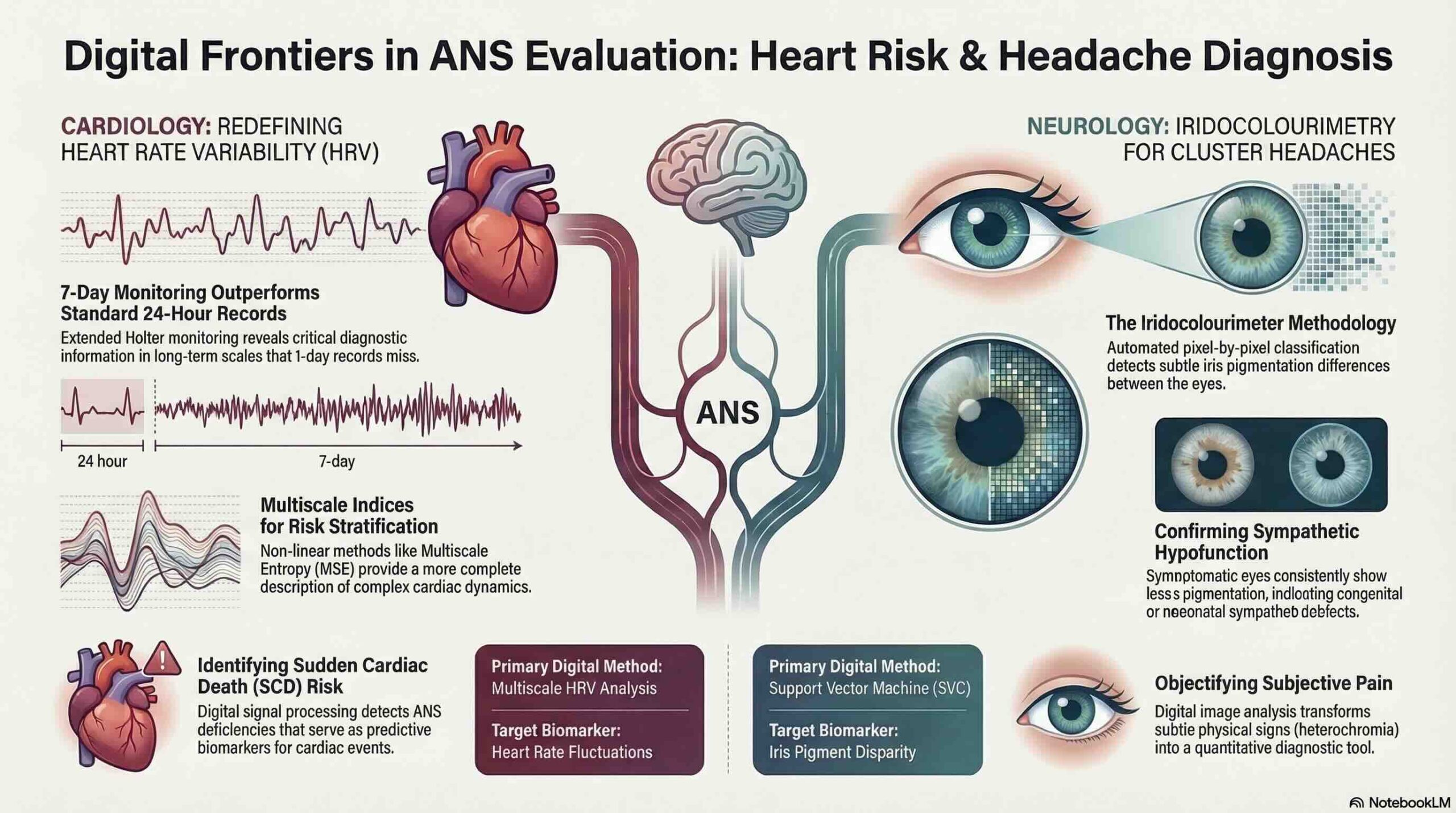
Infographic
Audio Summary
Key Findings
The research demonstrates that 7-day Holter monitoring significantly enhances the statistical robustness of HRV indices, particularly when distinguishing between the dynamics of Atrial Fibrillation (AF) and Chronic Heart Failure (CHF). By extending analysis up to 100 time scales, the researchers reduced estimator variance and revealed homeostatic data regarding long-term regulation that remains invisible in 24-hour records. Multiscale Entropy (MSE) exhibited the lowest bias and variance, proving highly effective at characterizing the noise-like irregularities inherent in AF signals. Conversely, while Multiscale Time Irreversibility (MTI) showed higher variance, it functioned as a sensitive indicator of the asymmetric dynamics that entropy-based measures might overlook. Furthermore, the analysis revealed that 24-hour monitoring windows frequently distort the Multifractal Spectrum (MFS), whereas 7-day signals provide a consistent and reliable representation of the heart’s multifractal nature.
In the neurological component of the study, the researchers validated the “Iridocolorimeter,” a specialized tool designed to detect subtle heterochromia that is imperceptible to the naked eye. Using Support Vector Machines (SVM) to analyze color-pixel vectors, the system successfully identified a correlation between sympathetic hypofunction and iris hypopigmentation on the symptomatic side of CH patients. This quantitative evidence suggests that the sympathetic defect associated with the pain is either congenital or acquired in the neonatal period, providing a definitive objective biomarker where previously only subjective pain reports existed. These findings demonstrate the maturing role of digital signal processing in modern clinical diagnostics.
Conclusion
The results of this study underscore the strategic value of long-term monitoring and high-resolution image analysis in providing robust ANS evaluations. By proving that 7-day Holter recordings offer superior statistical reliability for cardiovascular risk stratification and that machine learning can uncover hidden neurological markers, the research provides a disciplined framework for integrating digital signal processing into routine practice. These advancements remain proportional to the evidence, paving the way for improved diagnostic accuracy and better-informed clinical interventions in both cardiology and neurology.